


Zebra Technologies has recently conducted a new global “Warehousing Vision Study” to explore the trends and sentiments driving operational decisions and spending in warehouses. The findings releases deliver encouraging news: warehouse operators are making significant investments to better fulfil the needs of both customers and workers and make it easier to fill open jobs.
Conducted in January and February 2022, the survey collected feedback from more than 1,500 warehouse decision-makers and associates around the world. In Asia-Pacific (APAC), the markets surveyed for the study are India, Australia, China, Japan, and Singapore.
Market Pressures Become Catalyst for Positive Changes
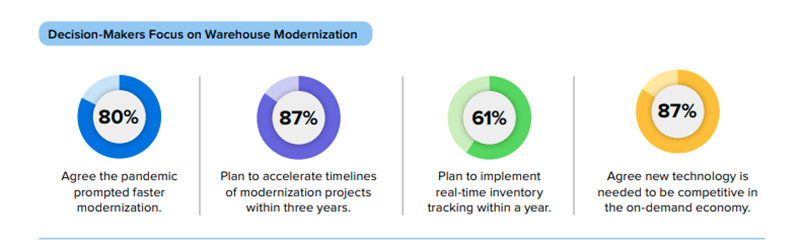
Nearly nine in 10 warehouse operators around the world agree they must implement new technology to be competitive in the on-demand economy, with 80% confirming the pandemic has prompted them to evolve and modernize more quickly.
In Europe specifically, over three-quarters of operators have accelerated their efforts. They’re turning their focus and spending most heavily toward technologies that support workforce augmentation and workflow automation. For example, the use of wearables, mobile printers and rugged tablets will increase in the next few years, along with mobile dimensioning software that automates parcel and carton measurements. Additionally, 23% of European warehouse operators have already deployed some form of autonomous mobile robots (AMR) today, which is in line with the global trend (27%). Within five years, that number is expected to grow to 88% in Europe and 90% around the world.
“We’re seeing a positive shift occurring in the supply chain and, specifically, within warehouses,” said Mark Wheeler, Director of Supply Chain Solutions, Zebra Technologies. “Most decision-makers believe investments in automation far outweigh the risk of doing nothing, and they are becoming more comfortable integrating all sorts of new technologies into their current operations and infrastructure.”
Warehouse associates are also becoming more comfortable with their employers’ use of advanced technologies. Less than half globally (45%) and in Europe (47%) say their employers have increased wages or offered bonuses amid labor constraints, yet most (82% globally and 81% in Europe) feel positively impacted by the situation.
Employers are improving work conditions in other ways, such as giving them more technology to use on the job and leveraging technology to create more flexible work shifts. In fact, an overwhelming nine in 10 warehouse associates agree on some level that technology advancements will make the warehouse environment more attractive to workers, even in times like these when supply chains are strained, demand is surging, and there’s increasing pressure to meet tighter deadlines.
Top Warehouse Challenges
Decision-makers are having a harder time getting customer orders out the door on time than they did three years ago, and they’re struggling to maintain inventory accuracy and visibility. They also admit they’re expected to deliver orders faster than ever to keep up with the on-demand economy, with rising transportation costs taking their toll on over 40% of warehouse operators spanning manufacturing, transportation, wholesale distribution, logistics and retail. This may not be surprising when you consider that respondents indicate their shipping volumes have increased more than 20% on average over the past two years.
Like associates, though, warehouse operators are viewing these challenges as catalysts for change and growth. Between now and 2025, over eight in 10 expect to increase the number of stock-keeping units (SKU) they carry and the volume of shipped items. They also plan to expand returns management operations, offer more value-added services, and increase their physical footprints, with both the number and size of warehouses increasing.
While six in 10 warehouse operators worldwide also want to increase headcount within the next year to right-size their workforces, around half admit finding (55%) and training (54%) workers in a timely manner remain big challenges. This is especially true in Europe, where 48% report it difficult to find workers and 50% say training is challenging. As a result, around eight in 10 decision-makers agree they will have to rely more on automation in the future.
Balancing the Scales: Augmenting the Workforce with Automation
While most warehouse operators both in Europe (88%) and globally (90%) will deploy AMRs for person-to-goods (P2G) picking, material movements and other automated inventory moves, 92% in Europe and 94% globally will invest in software that helps automate analytics and decision-making. They want to raise worker effectiveness and efficiency and reduce labor costs.
“As the pace of operations accelerates and workflows become more complex, warehouse operators have found the average time to get workers to full productivity is 4.7 weeks,” said James Lawton, Vice President and General Manager, Robotics Automation, Zebra Technologies. “Right now, decision-makers feel the most important labor initiative is to reduce unnecessary tasks so associates can focus on more customer-centric work. If warehouse operators automate through AMRs and workflow optimization software, it will be easier to scale operations and meet service level agreements as customer demands and labor availability fluctuate.”
Job Satisfaction – and Worker Retention – are Byproducts of Automation
With warehouse operators planning to increase automation, some might say jobs will be lost. Yet, study respondents believe automation may help keep more people in their jobs and fill empty ones. Over three-quarters of warehouse associates in Europe (75%) and worldwide (78%) say walking fewer miles per day would make their jobs more enjoyable, even if they had to pick or handle more items, and 81% strongly believe AMRs could make warehouse jobs less stressful.
Decision-makers should take note, as only 35% in Europe and 41% globally completely agree implementing warehouse technologies such as robotics and devices can help attract and retain workers even though most associates:
- who work alongside AMRs today confirm they have helped increase productivity and reduce walking/travel time (83%), reduce errors (73%), and enable advancement to new roles or opportunities (65%).
- claim they are more likely to work for an employer that gives them modern devices to use for tasks versus an employer that provides older or no devices (83% globally and 87% in Europe).
“Automation is the great equalizer, especially when labor is constrained or during unexpected surge periods or seasonal peaks when it may be difficult to scale the workforce quickly,” added Wheeler. “What’s interesting is associates feel more strongly about this than warehouse operators right now.”
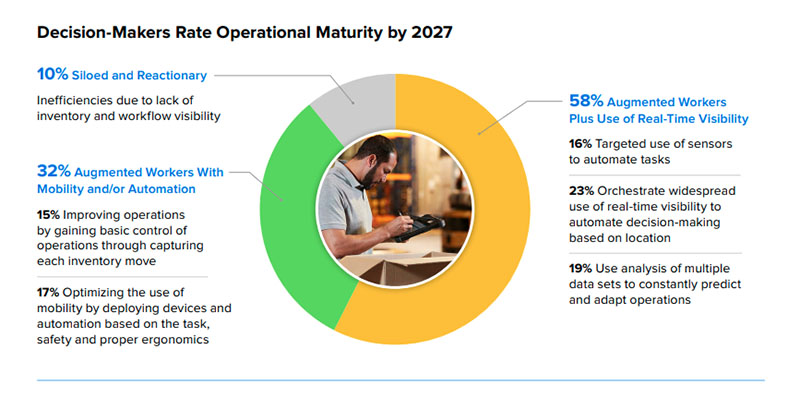
Five-year technology outlook
Globally, 85% of decision-makers say they have implemented mobility so front-line workers can capture each inventory move they make, and most feel they are optimising the use of their devices to fit the task, safety, and ergonomics.
However, warehouse associates (84%) and decision-makers (79%) are concerned they will not meet their business objectives unless more technology investments are made to improve operations, with associates in the transportation (92%) and logistics (88%) sectors feeling most strongly about this need.
As a result, more than six in 10 decision-makers said they will invest in technologies that increase inventory and asset visibility within their warehouses and overall visibility throughout supply chains over the next five years.
Nine in 10 expect their use of sensor-based technologies such as radio frequency identification (RFID), computer vision, fixed industrial scanning, and machine vision systems to become more prevalent over the next five years.
As businesses invest in advanced technologies that enable more visibility, real-time guidance and data-driven performance, they’re focusing on increasing team productivity and better utilisation of assets, equipment and people, which equates to improved worker well-being and overall market competitiveness. However, it will become critical for warehouse operators to become more thoughtful about how they implement and integrate technologies as they increasingly digitalise workflows and scale systems.









![[칼럼] IT/OT 융합 환경의 사이버 복원력 확보를 위한 OT 보안 아키텍처 및 AI 위협 탐지 기술 분석](https://icnweb.kr/wp-content/uploads/2023/02/rockwell-automation-mobileAna_900.jpg "[칼럼] IT/OT 융합 환경의 사이버 복원력 확보를 위한 OT 보안 아키텍처 및 AI 위협 탐지 기술 분석")












![[이슈] 스마트 공장 통신 표준 완성… IEC/IEEE 60802 TSN 통합 표준 발표](https://icnweb.kr/wp-content/uploads/2026/09/TSN_60802_standard_AI-900web.jpg "[이슈] 스마트 공장 통신 표준 완성… IEC/IEEE 60802 TSN 통합 표준 발표")