


2026 Emissions Gap Report highlights the urgent need for a 45% emissions cut by 2035 and a tripling of renewable energy capacity to keep the 1.5°C target alive.
The international goal to limit the global average temperature rise to 1.5°C above pre-industrial levels is at a critical crossroads. The international environmental organization Greenpeace has strongly urged governments to take urgent climate action ahead of the 31st UN Climate Change Conference (COP31) in Antalya, Turkey next month.
Greenpeace stated that a “Just Transition” away from fossil fuels must be rapidly accelerated. This urgent call is based on the latest emissions gap data from the United Nations Environment Programme (UNEP).
Widening Emissions Gap and the Looming 1.5°C Overshoot
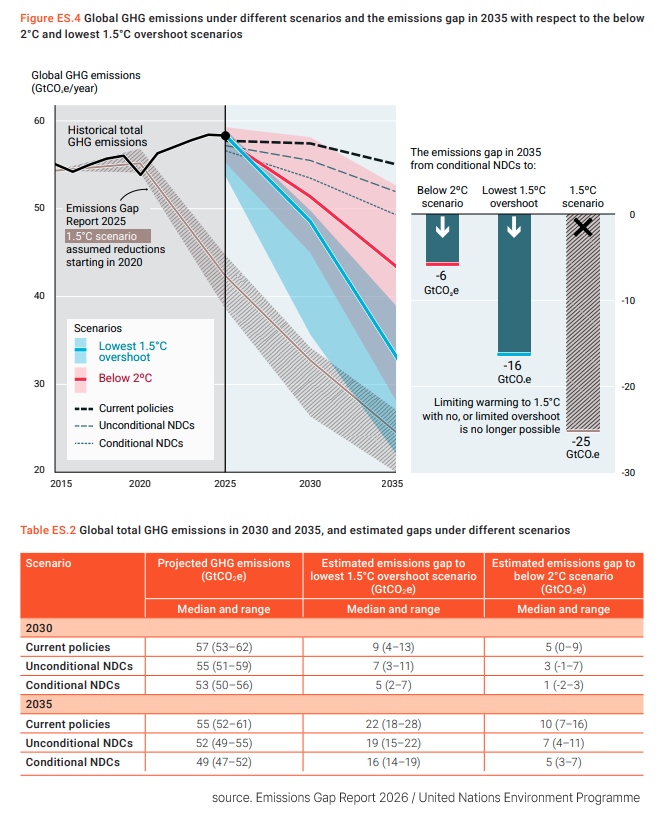
UNEP officially released the ‘Emissions Gap Report 2026: The Point of Return.’ The report warned that the global temperature rise could reach up to 2.8°C this century if current government policies continue. This is a significantly worse prediction compared to last year’s analysis.
However, rapid and drastic greenhouse gas emissions cuts can still limit the temperature rise to between 1.7°C and 1.8°C. The global temperature might temporarily exceed the 1.5°C limit. This phenomenon is known as an overshoot. Even with an overshoot, there is still a scientifically viable pathway to return below the target by the end of the century.
To achieve this recovery, global greenhouse gas emissions must be reduced by 18% by 2030, 45% by 2035, and 69% by 2040, based on 2025 levels. The large-scale deployment of Carbon Dioxide Removal (CDR) technologies is also an essential technical requirement.
Currently, the Nationally Determined Contributions (NDCs) submitted by governments are highly insufficient. The emissions reduction compared to 2025 levels will only be 5-8% by 2030 and 11-15% by 2035, even if all countries fully implement their pledged plans. This data proves a severe gap between the actual reductions required by climate science and current national policies.
Action Plans for Tripling Renewable Energy and Phasing Out Fossil Fuels
The deployment of Renewable Energy facilities, such as wind and solar power, is already producing some emission reduction results. However, the speed of energy infrastructure transition must be dramatically increased to minimize the overshoot of the 1.5°C limit.
Jasper Inventor, Deputy Programme Director at Greenpeace International, pointed out that this UNEP report is yet another strong alarm. He emphasized that delayed climate action leads to an exponential increase in climate damage. He strongly urged governments to face the reality of the climate crisis. He also added that strict accountability must be demanded from fossil fuel polluting companies, prioritizing citizens over corporate profiteers.
Greenpeace is demanding the immediate implementation of the first Global Stocktake (GST) energy goals agreed upon at COP28. Member states participating in the COP31 summit must triple the global renewable energy generation capacity by 2030. The rate of energy efficiency improvement must also be doubled. Furthermore, a fair and orderly transition away from fossil fuels must be fully realized within this critical decade.