


NODAR released the first demonstration of its Hammerhead™ 3D vision platform, taking an important step towards truly safe, mainstream autonomous driving. NODAR Hammerhead™ produces high-density 3D point-clouds at ranges up to 1,000m with astonishing accuracy, eclipsing mono-camera and LiDAR performance and paving the way to L3 and higher autonomy.
This unprecedented achievement includes small object detection at previously impossible ranges. In the demonstration released today, Hammerhead™ is used to detect and accurately measure the distance to a 10cm brick at a distance of 150m (video demo available at http://www.nodarsensor.com).
Reaching this milestone is groundbreaking in two key ways: 1) detecting unknown objects at 150m provides ample time to safely avoid collisions at highway speeds (4.5 seconds at 120kph/74mph) & 2) competitive solutions based on a single camera utilizing AI and inferencing may be able to detect known large objects at this range, however, many lethal obstructions will be unknown to these systems or too small, and will fail detection. NODAR’s technology measures the physical environment in real-time, providing distance data for every pixel in view, regardless of whether an object is known or unknown.
Beyond small object detection, NODAR Hammerhead™ delivers a new level of safety where existing solutions fall flat. Mono-camera solutions relying on deep learning to estimate depth are inherently limited by finite training sets, compute requirements, and known object ambiguity (adult vs. child can introduce range error of 50%), exposing life-threatening uncertainty. Numerous fatal and highly publicized accidents in recent years serve to emphasize the shortcomings of existing systems.
LiDARs rely on scanning beams and can easily miss small objects. The LiDAR scanning process takes precious time, whereas a camera-based system offers >20X the area coverage rate with the reliability, robustness, and low price of high volume solid-state cameras. Last, NODAR produces frame-by-frame disparity maps every 33 milliseconds while single-camera systems and LiDAR must aggregate and analyze data before producing results, causing significantly slower performance.
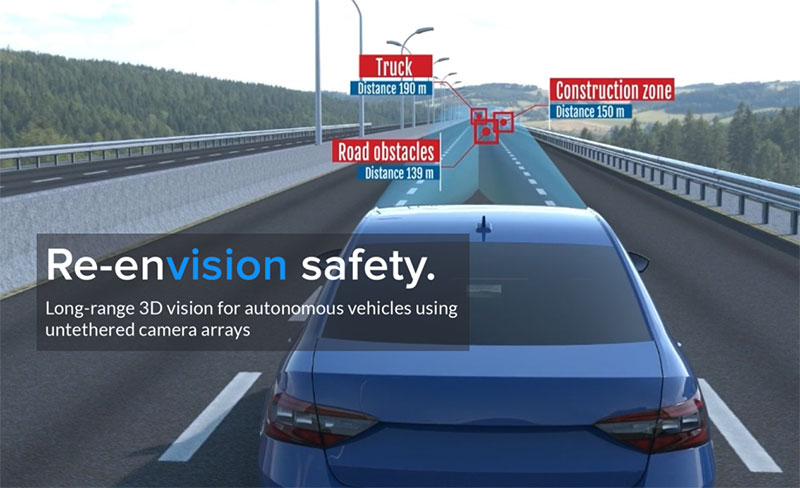
The significant advances in performance, accuracy, and reliability that NODAR brings will yield better performance around critical edge cases, higher levels of safety and an increase in lives saved, at lower cost than current approaches.
Bio-inspired by the hammerhead shark, which has the best depth perception in the animal kingdom due to the wide separation between its eyes, NODAR Hammerhead™ uses data from multiple cameras to calculate real physical measurements of distance to targets. The unique advantage of NODAR’s system is the ability to mount the cameras independently in long-baseline configurations, such as in the sideview mirrors, headlamps, or on the roof. With highly accurate long-range 3D sensing and no reliance upon inferred measurements, Hammerhead™ accurately captures instances of banked roads, disabled vehicles, and road debris – edge cases that other vision systems will miss.
Leaf Jiang, NODAR founder and CEO, speaks to the significance of today’s demonstration: “The automotive world knows that current ADAS systems must advance to ensure human safety. Today, we’ve taken a fundamental step towards demonstrating that higher levels of automated driving are achievable with existing sensor technology in the immediate term. At NODAR we believe autonomy should never compromise safety, and that a camera-based solution is the only way to deliver on the performance, safety, and pricing requirements of the mainstream automotive market.”
NODAR software algorithms run efficiently on OEM computing resources, processing image data from OEM-specified cameras. NODAR is currently engaged in POCs with several automotive OEMs and Tier 1s and is actively seeking partners.









![[칼럼] IT/OT 융합 환경의 사이버 복원력 확보를 위한 OT 보안 아키텍처 및 AI 위협 탐지 기술 분석](https://icnweb.kr/wp-content/uploads/2023/02/rockwell-automation-mobileAna_900.jpg "[칼럼] IT/OT 융합 환경의 사이버 복원력 확보를 위한 OT 보안 아키텍처 및 AI 위협 탐지 기술 분석")











![[이슈] 스마트 공장 통신 표준 완성… IEC/IEEE 60802 TSN 통합 표준 발표](https://icnweb.kr/wp-content/uploads/2026/09/TSN_60802_standard_AI-900web.jpg "[이슈] 스마트 공장 통신 표준 완성… IEC/IEEE 60802 TSN 통합 표준 발표")