


The proven communications standard Ethernet has been optimized through the addition of quality-of-service mechanisms. Various new IEEE standards will enable Ethernet to reliably transmit several protocols (including real-time-capable ones) in parallel within predefined maximum time limits. Industrial users and car manufacturer are already getting ready to employ it.
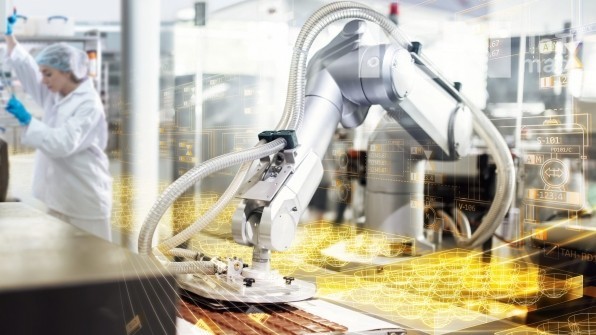
The steel arms move perfectly in step with one another and wave their grippers at the viewer. Not even the minutest delay is noticeable when the two industrial robots perform their graceful machine ballet. This perfect coordination is due to a technology that is currently ushering in a new era of industrial communication: Time-Sensitive Networking (TSN).
For the past 40 years or so, Ethernet has been the undisputed leader when it comes to the transmission of digital data through cables. Siemens has been there from the very beginning and even launched the first Industrial Ethernet network on the market: SINEC H1. As a result, Ethernet was not only used in offices but also, in particular, in industrial manufacturing. However, the standard had a problem from the very start – it could not guarantee that the data packets transmitted by the sender would arrive at the recipient within a certain amount of time. This is an unacceptable situation for industrial controllers – after all, sensor measurements and control signals musn’t take too long to arrive at their destination if a machine is to operate reliably. They need real-time communication within milliseconds – a task for which Ethernet was not originally conceived.
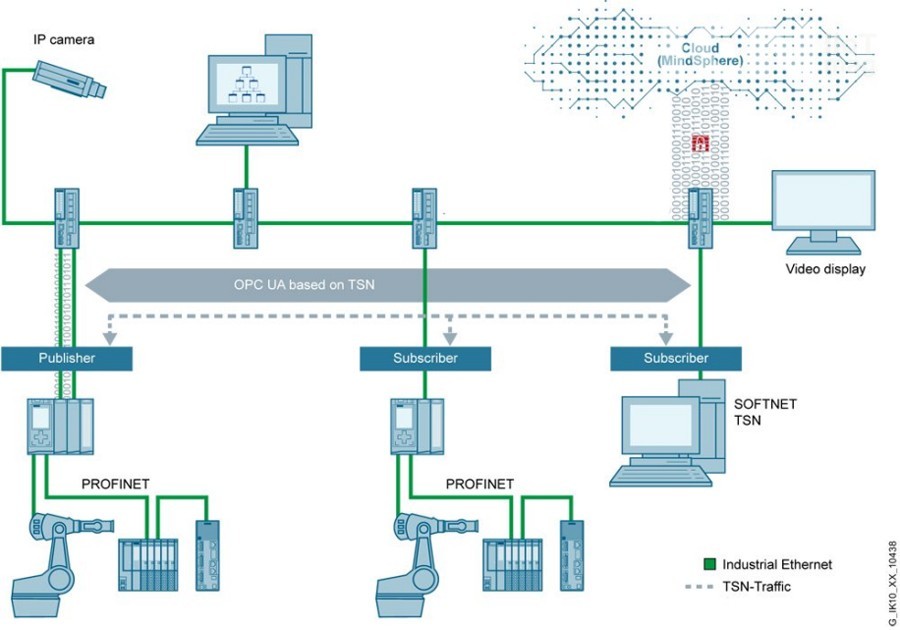
That’s why users who want real-time communication via Ethernet need to employ technological extensions such as the widespread Profinet standard. In machines, for example, this standard connects sensors, actuators, and drives to the central controller by adding real-time data transfer capabilities to Ethernet, enabling applications up to and including the precise control of servo drives. “However, to do that you generally need special hardware components inside the connected devices,” explains Matthias Gärtner, Head of System Management at the Simatic Controller unit of Siemens. “Moreover, the various real-time Industrial Ethernet solutions cannot be run in parallel on the same Ethernet network.”
TSN will enable all data – including real-time information – to be transmitted through a single network in effect simultaneously.
This problem will soon be a thing of the past, because the Institute of Electrical and Electronics Engineers (IEEE), which is responsible for standardizing various systems, has extended Ethernet by adding the urgently needed mechanisms for real-time communication. These include time-controlled transmission, synchronization, and bandwidth reservation. In this way, the IEEE is improving the quality of service by means of TSN. This will enable Ethernet to supply the same time information to all of the connected devices that support these extended standards. As a result, the entire network will be precisely synchronized. In addition, reservation protocols ensure that the data packets are transmitted from the sender to the destination via all the intervening switches according to a predefined timetable. The TSN standards also take into account the topology of the network in question – i.e. whether the network is arranged in the form of a star, a ring, or a line and the number of switches between the sender and the recipient. Moreover, the standards also include seamless redundancy processes.
A Single Network for All Data
“It’s a historic moment for Ethernet,” says Gärtner. “In the future, it will be possible to use standard hardware components for Profinet and other real-time industrial communication protocols that are based on TSN. This will enable all data – including real-time information – to be transmitted through a single network in effect simultaneously.” Users will automatically benefit from the steadily increasing bandwidth of standard Ethernet, which will be needed more and more as a result of the increasing IP connectivity of the automation systems. It will also make communication more robust because the switching resources in the TSN switches are firmly reserved for the requested real-time communication needs so that information can no longer be lost due to buffer overflows, for example.
In addition to a rising demand for real-time-capable communication in machines via Profinet, there is also a growing demand for deterministic (i.e. predetermined) data exchange between different machines. Examples include cooperative robots that simultaneously work on the same work piece and so need to precisely coordinate their movements with one another. The OPC UA standard with the PubSub (Publish/Subscribe) extension has now established itself in this area. It can also employ Ethernet with TSN as its transmission medium. “I expect Ethernet with TSN to be introduced into the entire industrial manufacturing process,” says Gärtner. “But that’s not all. Car manufacturer also want to use the new standard to transmit the large amounts of data from reversing cameras within vehicles, for example, or to make autonomous driving possible, which won’t be achievable without onboard networks that incorporate quality-of-service mechanisms.” The time for this has now come. The first TSN components are now being launched on the market and Siemens will use actual TSN products to demonstrate deterministic machine-to-machine communication over OPC UA PubSub at Hannover Messe 2018. These products will be purchasable at the end of the year, when Ethernet with TSN will have finally arrived in the modern world of digitalization and “Industrie 4.0”.
more info at http://www.siemens.com/tsn
[Box]
Interview about TSN: “Ideally Prepared for the Future”
Siemens is one of the driving forces behind the development of Ethernet with TSN. Sven Gottwald, Head of System and Vertical Management for Industrial Communication and Identification, explains how the application of the new standard benefits users.
Why is Ethernet with TSN such an important development?
Because it means that we no longer need different Industrial Ethernet solutions for deterministic communication in industry. In the future, they will all run on the widely used Ethernet with TSN and can do so in parallel without restrictions. This includes Profinet, OPC UA PubSub, and all other TCP/IP-based protocols. This convergence is a huge benefit for industrial users, because it enables all types of data to be transmitted through a single physical network in which time-sensitive information always has precedence so that it reliably arrives on time. That’s precisely what companies need in order to fully exploit the potential of digitalization and “Industrie 4.0”.
How does Ethernet with TSN regulate the “timetable” for the data?
The Institute of Electrical and Electronics Engineers (IEEE), which is responsible for the standardization, provides two options for this: It’s either done by a central unit or the connected devices negotiate it among themselves. As a member of the “Labs Network Industrie 4.0” (LNI4.0) testbed, Siemens prefers the second option because the use of a central unit requires extensive reconfiguration every time a change occurs in the network. However, if the system configures itself, it’s easy to integrate new devices. That’s why we talk of “Plug & Work”-capable networks, which greatly benefit our customers.
What is Siemens doing with regard to Ethernet with TSN?
The entire automation industry is working hard on this topic of course. However, Siemens is certainly one of the leading companies in this area. We are actively involved in all of the major standardization bodies, such as the IEEE, the IEC, the OPC-F, and the PI. We also supply the editor for some of the TSN IEEE standards.
The first TSN products will start shipping before the year is out. That’s why our customers are ideally prepared for the digital future with Siemens.









![[칼럼] IT/OT 융합 환경의 사이버 복원력 확보를 위한 OT 보안 아키텍처 및 AI 위협 탐지 기술 분석](https://icnweb.kr/wp-content/uploads/2023/02/rockwell-automation-mobileAna_900.jpg "[칼럼] IT/OT 융합 환경의 사이버 복원력 확보를 위한 OT 보안 아키텍처 및 AI 위협 탐지 기술 분석")












![[이슈] 스마트 공장 통신 표준 완성… IEC/IEEE 60802 TSN 통합 표준 발표](https://icnweb.kr/wp-content/uploads/2026/09/TSN_60802_standard_AI-900web.jpg "[이슈] 스마트 공장 통신 표준 완성… IEC/IEEE 60802 TSN 통합 표준 발표")