


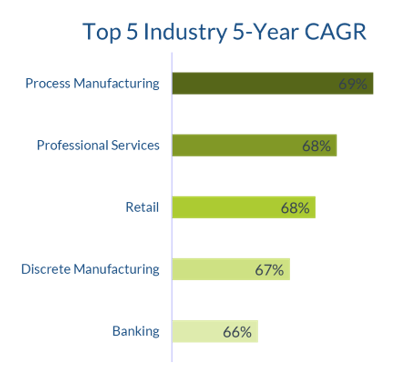
IDC’s new Worldwide Semiannual Blockchain Spending Guide predicts continuous growth in blockchain spending across Europe, from over $800 million in 2019 to $4.9 billion in 2023, growing at a CAGR of 65.1% between 2018 and 2023. Despite a smaller CAGR compared with the average growth forecast for 2017–2022, knowledge about opportunities in blockchain is spreading from big enterprises to emerging start-ups looking to ensure secure and reliable management of money, personal data, and assets, which is proving to be necessary in a digitalized and data-driven market.
The perception of blockchain in the European market (and worldwide) is moving away from being only a cryptocurrency tool and a financial-only technology. Blockchain originated in the banking industry, and banking still accounts for 31% of total spending in 2019, with cross-border payments and trade finance the fastest-growing banking use cases. With blockchain well established in banking, other industries are increasingly stepping up and taking part in the digital transformation.
Manufacturing, professional services, retail, and banking show the greatest promise in their future investment in blockchain with above average CAGRs, hoping to improve transparency and assured authenticity in their businesses.
New use cases are emerging, driven by growing awareness of what blockchain is and what it can and cannot do. Blockchain enables companies to cut out the middleman, thereby saving costs and reducing risks of fraudulent behavior and human error. Identity management is a new use case on the rise in Europe, being implemented in insurance, banking, government, and personal and consumer services. With data emerging as one of the most valuable resources, it is becoming crucial for companies to have an effective and safe way to store, secure, and use consumers’ personal data. Blockchain offers a decentralized and encrypted system to do this and it is now being used for a range of purposes, including i-voting (internet/electronic voting) and intellectual property management.
“Companies are beginning to view blockchain not only for its cryptographic means, but rather as a management tool that can keep track of items, information, and customer data. This is something that can be used by the transportation industry to track shipments, by top-quality luxury goods retailers to track provenance, or by real-estate professionals for transparent property management,” said Carla La Croce, senior research analyst, Customer Insights and Analysis, IDC. “As spending continues to grow, the market will most likely adapt and security and validity will become a customer standard, with more companies turning to blockchain for a safe and reliable solution.”
There are some challenges, however, according to Mohamed Hefny, program manager, Systems and Infrastructure Solutions, IDC. These include the lack of rules and regulations, and getting small producers of goods, like farmers and fishermen, to use the enterprise platforms. “However, the recognition from the European Commission of blockchain’s importance to a single digital market and the work done by the big cloud blockchain service providers to create simple mobile apps for their smaller consortium members, and similar developments, are very promising,” he said.
IDC’s Worldwide Semiannual Blockchain Spending Guide quantifies the emerging blockchain market by providing spending data for 10 technologies across 19 industries and 16 use cases in nine geographic regions. IDC defines blockchain as a digital, distributed ledger of transactions or records. The ledger, which stores the information or data, exists across multiple participants in a peer-to-peer network. There is no single, central repository that stores the ledger. Distributed ledger technology (DLT) enables new transactions to be added to an existing chain of transactions using a secure digital or cryptographic signature. Spending associated with various cryptocurrencies that utilize blockchain and DLT, such as Bitcoin, is not included in the spending guide. Unlike other research in the industry, the comprehensive spending guide was designed to help IT decision makers to clearly understand the industry-specific scope and direction of blockchain spending today and over the next five years.







![[칼럼] IT/OT 융합 환경의 사이버 복원력 확보를 위한 OT 보안 아키텍처 및 AI 위협 탐지 기술 분석](https://icnweb.kr/wp-content/uploads/2023/02/rockwell-automation-mobileAna_900.jpg "[칼럼] IT/OT 융합 환경의 사이버 복원력 확보를 위한 OT 보안 아키텍처 및 AI 위협 탐지 기술 분석")








![[이슈] 스마트 공장 통신 표준 완성… IEC/IEEE 60802 TSN 통합 표준 발표](https://icnweb.kr/wp-content/uploads/2026/09/TSN_60802_standard_AI-900web.jpg "[이슈] 스마트 공장 통신 표준 완성… IEC/IEEE 60802 TSN 통합 표준 발표")