


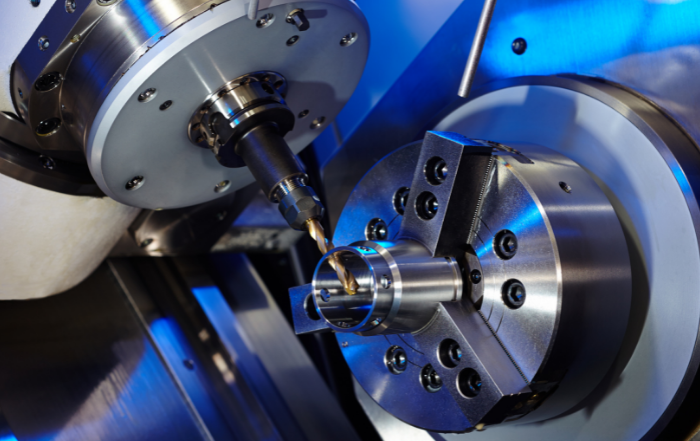
Across a wide variety of different application areas, there are increasing expectations being placed on machine tools. The feature sizes that need to be dealt with are getting smaller, and as resolution requirements increase, so too must the accuracy of the encoder. There are increasing demands for greater precision elsewhere too – including aerospace and power generation applications.
The OEM market is a highly competitive and cost driven one, with many rival manufacturers. For this reason, manufacturers are constantly trying to find ways to increase their margins by making equipment that require less engineering resources and cost less to produce.
At the same time, the encoders used in the equipment need to deliver higher degrees of resolution (in many cases orders of magnitude higher), and still be sufficiently robust to work in uncompromising industrial environments. Unfortunately, current technologies struggle to address both these demands simultaneously.
 The Graphene Hall Effect Sensor (GHS) technology that Paragraf has pioneered offers very clear advantages to encoder manufacturers looking to differentiate their products, and ensure they get designed into the next generation machine tools. Thanks to the unique properties of their graphene sensor elements, Paragraf GHS devices overcome the problems associated with conventional magnetic sensors.
Existing encoder technologies
Optical encoders have high resolutions, but they are not designed to function in harsh working environments. Magnetic encoders have the capacity to operate in harsher conditions than optical ones, but they have the drawback that their resolutions are significantly lower, meaning they cannot achieve the accuracy that is now being called for.
Why GHS is the answer
By using Paragraf GHS magnetic sensors, encoder manufacturers will be able to derive several key performance advantages that will give them a competitive edge. This will bring together the plus points of optical and conventional magnetic encoder approaches.
GHS devices offer:
- Industry-leading resilience to shock and vibration, thanks to the robust nature of graphene.
- They have neither planar Hall nor hysteresis effects, so the magnets aren’t influenced by noise emanating from stray fields. The upshot of all this is encoder designs won’t need as much magnetic shielding – thereby reducing the overall expense and payload.
- Higher resolutions are possible with fewer components, resulting in simplified systems.
- The calibration requirements during the production phase will be lowered through, less time being taken up by technicians carrying out such work will translate into major engineering cost reductions. Once deployed, there will be less need for encoder re-calibration on the tooling equipment – leading to greater convenience for the end customer, with less downtime and greater productivity.
In conclusion, encoder manufacturers want to get away from producing heavily engineered arrangements that add to the size, cost and weight of their solutions. Adopting graphene-based sensors will help them to achieve higher levels of precision in their products and bring real benefits to the industrial OEMs that they serve.
By reducing the number of magnets and sensors needed in their encoders, lowering the amount of shielding required and curbing their engineering expenses, they will be able to make the unit pricing more attractive for OEMs whilst achieving the resolution required to meet customers’ demands.







![[진단] 테솔로 IPO가 던지는 의미… 피지컬 AI 시대, 로봇핸드가 새로운 AI 반도체가 된다](https://icnweb.kr/wp-content/uploads/2026/06/DG-5F-S-tesollo-robot-hand-1024x683.jpg "[진단] 테솔로 IPO가 던지는 의미… 피지컬 AI 시대, 로봇핸드가 새로운 AI 반도체가 된다")
![[분석] SEMI, AI가 메모리 투자 판도 바꾼다](https://icnweb.kr/wp-content/uploads/2026/06/semi-300mm-fab-Equip-spending-1Q-2026-icnweb.png "[분석] SEMI, AI가 메모리 투자 판도 바꾼다")












![[이슈] 초당 3,400개 토큰 쏟아낸다… 엔비디아, 에이전틱 AI 가속기 ‘그록 3 LPX’ 전격 양산](https://icnweb.kr/wp-content/uploads/2026/08/NVIDIA-Groq3-1-800web.png "[이슈] 초당 3,400개 토큰 쏟아낸다… 엔비디아, 에이전틱 AI 가속기 ‘그록 3 LPX’ 전격 양산")