


AI-driven Spot revolutionizing manufacturing automation
Acoustic vibration sensing enhances predictive maintenance
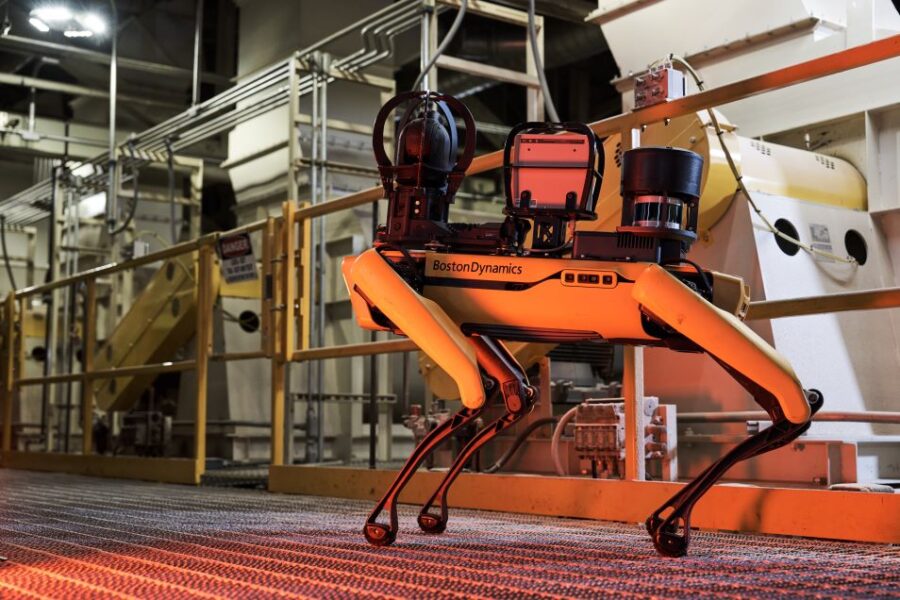
Spot at the Heart of Manufacturing Automation
Boston Dynamics’ Spot has emerged as a game-changing robotic solution in manufacturing and industrial automation. Companies are increasingly integrating Spot into their operations to improve equipment reliability, streamline maintenance, and address workforce shortages. By automating repetitive tasks and providing actionable data, Spot is transforming decision-making processes across industries.
1. Acoustic Vibration Sensing: Revolutionizing Equipment Maintenance
Over 1,500 Spot robots are deployed globally, proactively monitoring industrial equipment for early signs of failure. One of the most impactful use cases has been acoustic leak detection, which has demonstrated a return on investment within two years for most customers.
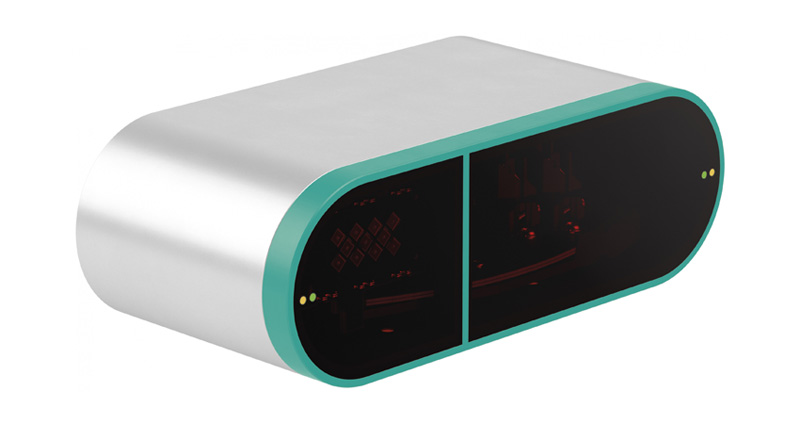
Now, with the addition of acoustic vibration sensing, Spot can conduct ultrasonic inspections of rotating equipment. Bearings, which are critical components in conveyor belts and other machinery, often degrade over time. Spot, equipped with the Fluke SV600 acoustic imager, can now detect early signs of bearing wear before it leads to catastrophic breakdowns.
This capability eliminates the need for additional inline sensors or manual inspections, making predictive maintenance more efficient and cost-effective. Spot now serves as a multi-functional maintenance tool, capable of detecting air leaks, overheating machinery, gauge anomalies, and bearing failures—all within a single deployment.
2. Reality Capture: Enabling Digital Twin Implementation
Industrial environments are constantly evolving, making real-time monitoring and proactive planning essential. Companies are increasingly leveraging digital twins, virtual models that mirror real-world facilities and equipment to enhance operational control and predictive analytics.
Spot’s latest update introduces laser scanning integration via the Leica BLK ARC payload, allowing seamless reality capture missions. Operators can plan, execute, and monitor these missions through Orbit, Boston Dynamics’ mission management platform.
This 3D scanning capability supports:
- Factory design: Creating visual representations of existing spaces for brownfield site planning.
- Equipment installation: Identifying potential clashes in layout planning.
- Employee training: Onboarding new staff with immersive, real-world digital models before they step onto the factory floor.
By increasing data capture frequency without raising operational costs, Spot outperforms manual scanning methods, making reality capture a scalable, cost-effective solution for industrial facilities.
3. Orbit Updates: Cloud-Based Management and Multi-Docking System
Boston Dynamics’ Orbit platform provides centralized management for Spot’s operations, enabling seamless fleet control, data analysis, and system integration.
Key updates include:
- Multi-Docking System: Spot can now recharge autonomously at multiple stations along its route, enabling longer mission durations without human intervention.
- Alert Triage System: Operators can now categorize, prioritize, and dismiss alerts in one-click batch processing, ensuring critical issues are addressed swiftly.
- Cloud Expansion: Orbit’s cloud-based deployment is now available in North America, Korea, Japan, the EU, Brazil, Singapore, and Australia, allowing global enterprises to scale operations efficiently.
For organizations preferring on-premise deployment, Site Hub still offers full visibility and control over Spot’s fleet, ensuring flexibility in infrastructure choice.
4. Enhanced Mobility: Smarter Navigation in Complex Environments
Spot’s mobility improvements make it even more adaptable to dynamic industrial settings. Key enhancements include:
- Advanced Obstacle Detection: Spot can now identify and avoid common industrial hazards such as carts, wires, and ladders.
- Wider Field of View: The robot perceives more obstacles and determines alternative paths more efficiently.
- Safer Stair Navigation: New built-in checks improve ascent and descent stability and safety.
By integrating visual semantic context, Spot’s navigation system now interprets its surroundings with greater accuracy, making it a more reliable autonomous solution for factories, warehouses, and hazardous sites.
5. Hardware Upgrades: Improved Usability and Durability
Boston Dynamics has also introduced key hardware improvements to enhance user experience and reliability.
- Tablet Controller Pro:
- Ergonomic joystick design with larger buttons and extended battery life.
- USB-C to HDMI pass-through for seamless screen mirroring on external displays.
- Extended Operating Temperature:
- Spot can now withstand temperatures up to 55°C (previously 45°C), making it viable for high-temperature environments.
- Core I/O Enhancements:
- Stronger antenna for improved wireless connectivity and extended operational range.
Spot’s Role in the Future of Industrial Automation
Boston Dynamics continues to evolve Spot’s capabilities, positioning it as a core automation solution for manufacturing. The latest updates—acoustic vibration sensing, digital twin integration, enhanced navigation, multi-docking, and cloud-based fleet management—solidify Spot’s role as a transformational tool in industrial operations.
As AI and robotics technology continue advancing, Spot’s role in automation will only expand, making it a cornerstone of the future smart factory.





![[전문가기고] K-배터리 3사, ‘Beyond EV’ 시장을 향한 기술 초격차 전략 비교 [인터배터리 2026]](https://icnweb.kr/wp-content/uploads/2026/03/battery-P3-beyond-Battery-web-1024x576.png "[전문가기고] K-배터리 3사, ‘Beyond EV’ 시장을 향한 기술 초격차 전략 비교 [인터배터리 2026]")
![[심층기획] 피지컬 AI의 심장 ‘이차전지’, 휴머노이드 로봇 혁명 이끈다 [인터배터리 2026]](https://icnweb.kr/wp-content/uploads/2026/03/Battery-pack-interB-Phy-AI.png "[심층기획] 피지컬 AI의 심장 ‘이차전지’, 휴머노이드 로봇 혁명 이끈다 [인터배터리 2026]")




![[칼럼] 제조업 생존 가르는 EU CRA와 피지컬 AI 보안 전략](https://icnweb.kr/wp-content/uploads/2026/03/CRA-2026-notebookLM-20260326-1024web.png "[칼럼] 제조업 생존 가르는 EU CRA와 피지컬 AI 보안 전략")



![[#HM24] HARTING, 미래 핵심인 전기에너지에 열정을 쏟다](https://icnweb.kr/wp-content/uploads/2024/04/HM24-HARTING_TECO-2030-900web.jpg "[#HM24] HARTING, 미래 핵심인 전기에너지에 열정을 쏟다")
![[#HM24] 안전한 데이터 교환의 상생적 이점](https://icnweb.kr/wp-content/uploads/2024/04/roseman-labs-hm24_3_2-1024x683.jpg "[#HM24] 안전한 데이터 교환의 상생적 이점")

![[#HM24] 벡호프, AI 모델 생성을 간소화하는 AutoML 도구 출시](https://icnweb.kr/wp-content/uploads/2024/04/TwinCAT-ML-Creator-Dr-Fabian-web.png "[#HM24] 벡호프, AI 모델 생성을 간소화하는 AutoML 도구 출시")